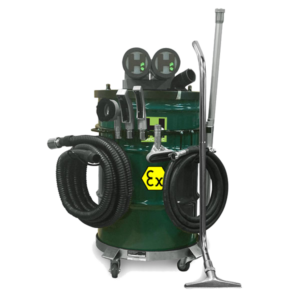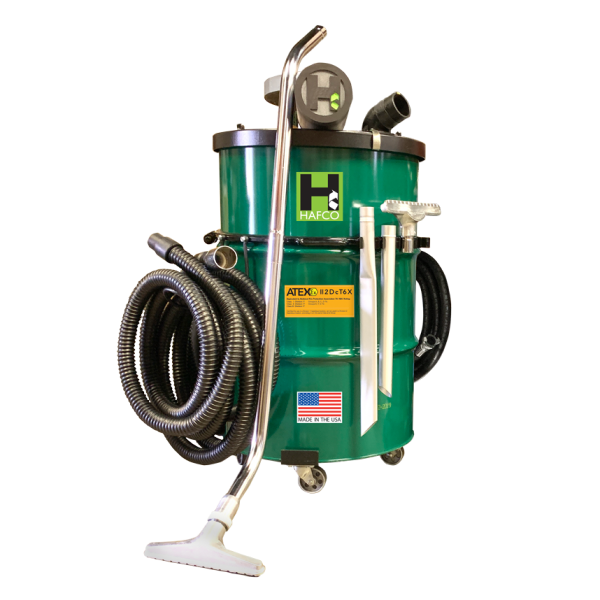
HafcoVac Vacuums are Intrinsically Safe
 HafcoVac Pneumatic Explosion-Proof vacuum cleaners are ATEX Certified and safe for use in hazardous locations as part of a combustible dust cleaning program. They are suitable for use in many industries that have flammable and combustible materials in their locations. HafcoVac Pneumatic Vacuums do not use electricity and are a safe, reliable, and cost effective solution for your business. Our vacuums do not have a motor or any moving parts that could create arcing, friction or sparking but operate on compressed air. Risks of explosions can occur in an environment where combustible materials or substances are mixed with air and there is an ignition source present. By complying with NFPA 652 and 484 as well as OSHA Housekeeping Guidelines, HafcoVac is the safest and most cost-effective option available. HafcoVacs are designed to eliminate the risks of these potentially catastrophic situations. A Lifetime Warranty and Same Day Shipping add unbeatable value.
What’s in the Box?
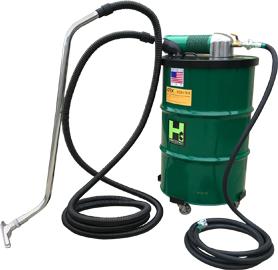
Complete turnkey solutions for your vacuuming needs with unparalleled performance, reliability and value. Just unpack and connect to your air supply and your ready to clean.
18 Gauge Drum
Vacuum Generating Head
Vacuum Hose
20′ x 3/4″ ID Air Supply Line
Caster Base (Drum dolly)
Wet/Dry Floor tool with 4″ wand
Crevice Tool
Filter (HEPA standard on Explosion-Proof models, optional on others)

Configuring Your Vacuum
Our Certified Vacuum Configurator and Anti-Static Vacuum Configurator will allow you to design and build the system specifically for your facility. It is intended to help you choose the most appropriate Pneumatic Vacuum Cleaner for your application. Our sales staff are always standing by for any assistance so you can always contact us for additional guidance.
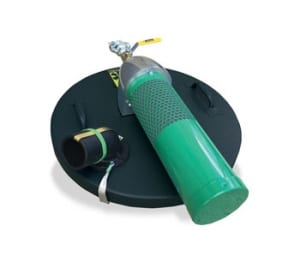 If you already have a quality 18 gauge (1.1mm) drum, our Vacuum Head and Tools package might fill your needs. The Head & Tools configuration includes everything in the Complete Vacuum package, except for the drum and dolly. For best performance, we recommend the Complete Vacuum System but if you would like to use your own drum please note the following important considerations:
HafcoVac Vacuum Generating Heads
Our Vacuum heads create a powerful vacuum when installed on your own 30 or 55 gallon drums. Due to the powerful suction created please ensure that your drum is constructed of a minimum of 18 gauge (1.1mm) steel if your drum was not purchased from HafcoVac. Use of a thinner gauge steel or a damaged drum can result in collapse of the drum and possible damage to the vacuum head and injury.
Drums
Drums must be a standard size 30 or 55 gallon steel drum constructed of 18 gauge (1.1mm) thick steel. The HafcoVac Vacuum Heads rests on the top of the drum and is held fast by the strong Venturi suction. If the drum is not a standard size or lacks a smooth lip, the head will not fit or can fail to create a good seal. If your drum is not at least 18 gauge it will implode under the extreme vacuum pressure created inside.
Explosion-Proof
When ordering an Explosion-Proof vacuum model, you must ensure your drum is fully grounded to ensure static electricity dissipation. Contact us if you would like to purchase an explosion proof head without a drum and are unsure of grounding procedures.
Compressed Air Requirements
All HafcoVac industrial vacuums operate using compressed air and do not use electricity. The air supply requirement is determined by your application and the availability of your air supply. In general, HafcoVac 60 requires a minimum of 45 CFM and HafcoVac 100 requires 85 CFM. See the chart below for more information.
| 18 CFM Models | 5 HP Minimum |
| 48 CFM Models | 10 HP Minimum |
| 85 CFM Models | 20 HP Minimum |
| 185 CFM Models/Dual Venturi | 40 HP Minimum |
Vacuum Hose Selection
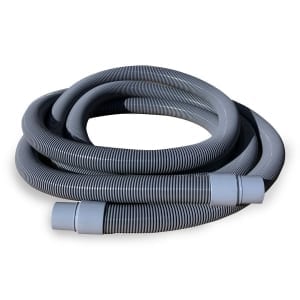 Vacuum hoses are available in either 1.5? or 2? diameter. In general, a smaller diameter hose will perform better than a larger.
Considerations for Choosing a Hose Size:
Material Size
If the material being picked up is larger than 1? in diameter than choosing the larger diameter hose will prevent clogging.
Length of Hose
If you are requiring more than 25? of hose than a smaller diameter hose will perform better.
Accessories
We carry a full line of 1.5? accessories and 2? accessories. Click here to view accessories.
Hot, Abrasive, Static or Explosive Material
If the material to be picked up is hot, abrasive or prone to static buildup or explosive we carry Heavy Duty and Static Conductive hoses.
Drum Sizes
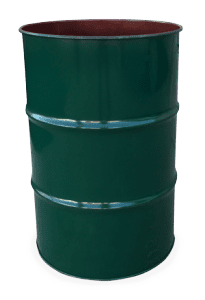 HafcoVac Industrial Pneumatic Vacuums require a 30 Gallon or 55 Gallon Drum to operate. The drum collects the vacuumed material and creates the sealed chamber that generates the vacuum suction. Both size drums perform the same but below are considerations to help choose a size:
Space Constraints
The size of your work area will help determine the size you need. A 30 gallon unit might be a better fit at a constrained workstation.
Density and Volume of Material
Determine if a 55 Gallon Drum full of the recovered material would be too heavy to safely manage versus a 30 Gallon Drum. Other considerations include whether a 30 Gallon Drum would have to be emptied too frequently. With our years of experience we can advise you of the correct size for your facility and needs.
HafcoVac HEPA Filtration
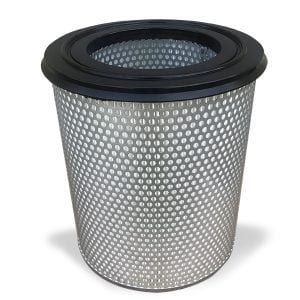 High Efficiency Particulate Air (HEPA) filtration is available for all HafcoVac models. HafcoVac Industrial HEPA Vacuum Filtration is standard on all Explosion-Proof Industrial Vacuums.
Typical applications for HEPA industrial vacuum cleaners include:
Asbestos abatement
Lead paint recovery
Healthcare facility cleanup
Pharmaceutical manufacturing
Food processing
Mining
Power Generation
Combustible dust preventative maintenance
Detailed specifications on the filter media used in our filters can be found here. These specifications are verified using a DOP test as per US Military spec MIL-STD-282. HafcoVac HEPA filters are manufactured to True (Absolute) HEPA standards, 99.97% efficient at .3 micron. With a HafcoVac HEPA filter properly installed on a well maintained vac, you can rest assured your employees safety is accounted for. When using HEPA filtration, please pay extra attention that the filter is well secured with the retaining springs, and that all seals and gaskets are intact and in good condition. Failure to observe these warnings can result in air escaping without proper filtration, severely reducing the effectiveness of the filter.
All of our units can be upgraded to a HEPA industrial vacuum by purchasing the HV-7063 HEPA Filter.